Dams and Reservoirs: Future Dates, Prevention, Maintenance, and Community Preparedness

By Jucelino Luz
Introduction: Prevention Means Protecting Lives
Dams are major engineering structures that perform essential functions for society, including water supply, power generation, flood control, irrigation, and economic development. However, no human-built structure is permanently free from risk. Dams age and are affected over time by climate conditions, erosion, geological changes, and their continued operation. For this reason, they require continuous inspection, maintenance, modernization, and monitoring.
Dam safety should not be treated solely as an engineering matter. Above all, it is a matter of public safety, environmental protection, and the preservation of human life.
In different parts of the world, there are dams classified as presenting high levels of risk or potential damage. Aging infrastructure, extreme rainfall, flooding, changing climatic conditions, and possible deficiencies in regulatory oversight may increase the vulnerability of these structures.
For this reason, the purpose of this document is fundamentally educational and preventive. It is not intended to create fear or panic, nor to claim that any particular disaster will inevitably occur. Its purpose is to draw attention to three fundamental pillars:
community preparedness, permanent maintenance of structures, and the strengthening of safety and emergency systems.
1. Community Preparedness Must Begin Before an Emergency
A well-prepared community is better equipped to respond quickly and in an organized manner when faced with a hazardous situation.
Residents of areas located downstream from dams should receive clear and accessible information regarding potentially affected areas, evacuation routes, safe assembly points, warning systems, and procedures to be followed in an emergency.
Such preparedness should not begin only when a problem arises. It should form part of a permanent preventive education program.
Schools, hospitals, businesses, public institutions, community organizations, and families need to understand basic safety procedures. Periodic evacuation drills can help ensure that, in a real emergency, people know how to respond without relying exclusively on last-minute instructions.
Accurate information can save lives.
2. Permanent Maintenance: A Responsibility That Cannot Be Postponed
Among the technical factors that may compromise a dam are internal erosion, seepage, overtopping, foundation problems, inadequate spillway capacity, and instability associated with seismic phenomena. Older structures may also have been designed according to technical standards and environmental conditions that differ from those of today.
For this reason, maintenance must be regarded as a permanent and high-priority activity.
Regular inspections must identify, at an early stage, cracks, seepage, deformation, erosion, gate failures, spillway problems, foundation changes, and other signs that may indicate a reduction in safety.
Resources allocated to maintenance must be used responsibly, transparently, and according to technical priorities. Postponing essential repairs can transform an initially manageable problem into a major emergency.
Maintenance is not an unnecessary expense; it is an investment in the preservation of human life, the environment, and public and private property.
3. Safety Requires Continuous Monitoring
Modern technologies make it possible to monitor different dam parameters virtually in real time.
Sensors, weather stations, geotechnical instruments, reservoir-level measurement systems, and other monitoring mechanisms can help specialists identify changes before they develop into critical situations.
However, technology without emergency planning is not sufficient.
Every facility should have clearly defined procedures for different levels of risk, including immediate communication among operators, civil protection and civil defense authorities, local governments, emergency services, and potentially affected communities.
Whenever a concrete risk exists, the population must receive official information quickly, clearly, and objectively.
4. International Examples Should Serve as Lessons
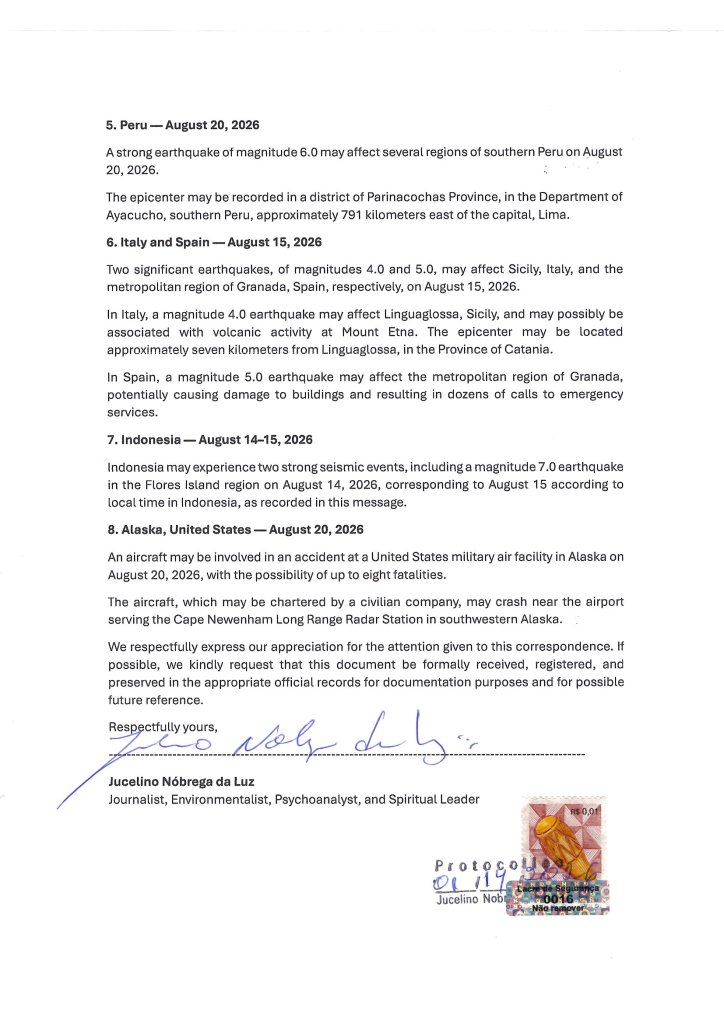
The original document brings together examples of dams and reservoirs in countries including Iraq, the United States, Zambia, Zimbabwe, the United Kingdom, Peru, India, Nepal, Australia, China, and others, presenting concerns associated with aging, erosion, seismic events, extreme rainfall, conflicts, structural problems, or maintenance difficulties.
These examples should primarily be presented as preventive case studies, rather than as assertions that a particular structure will necessarily collapse.
International experience demonstrates that previous incidents can reveal important vulnerabilities. The incident at Oroville in 2017, for example, required a large-scale evacuation following problems with the spillways.
Cases of this nature should encourage governments, engineers, operators, and communities to ask:
Are we prepared if an emergency occurs?
From a preventive standpoint, this question is far more important than attempting to determine in advance whether a tragedy will actually occur.
5. Dates and Predictions Should Not Cause Panic
The original text presents dates associated with possible future events and subsequently clarifies that they do not represent predestined outcomes, emphasizing the preventive and educational nature of the message.
This clarification is fundamental.
Any prediction, personal perception, spiritual interpretation, or indication concerning a possible future event must be clearly distinguished from a technical engineering assessment.
The official determination of a dam’s safety level must remain the responsibility of qualified engineers, regulatory agencies, competent authorities, and civil protection and civil defense institutions.
Therefore, any dates mentioned should be understood exclusively within the context of the predictions presented by the author, and not as technical confirmation that a dam will fail on that date.
The responsible objective should be to use any warning as an incentive for prevention, never as an instrument for creating fear.
6. Extreme Rainfall and Environmental Changes Require Planning
Severe weather events can rapidly raise reservoir levels and increase pressure on drainage systems, spillways, and gates.
The text presents situations involving heavy rainfall and water releases from reservoirs in China, demonstrating how downstream communities may become vulnerable when large volumes of water must be managed during critical periods.
This reinforces the need to integrate engineering, meteorology, water-resource management, civil defense, and public communication.
Planning for extreme situations does not mean asserting that they will occur. It means recognizing that, should they occur, previously established procedures will be available to reduce loss of life and material damage.
7. A Permanent Education Program for At-Risk Areas
One of the most important points presented in the original document is the need to expand education for people living in vulnerable areas and to establish structures dedicated to preventive guidance and emergency preparedness.
This proposal deserves particular attention.
Education, Prevention, and Emergency Preparedness Centers could be established, particularly in regions near dams, rivers, hillsides, and areas vulnerable to flooding, earthquakes, tsunamis, wildfires, and other natural or technological hazards.
Such centers could continuously provide community education, volunteer training, risk mapping, evacuation exercises, first-aid instruction, environmental guidance, household preparedness, and emergency communication.
Children and young people should also receive age-appropriate preventive education. Developing a culture of prevention beginning in school can help create significantly more resilient communities in the future.
Preventive Note Regarding the Dates Presented
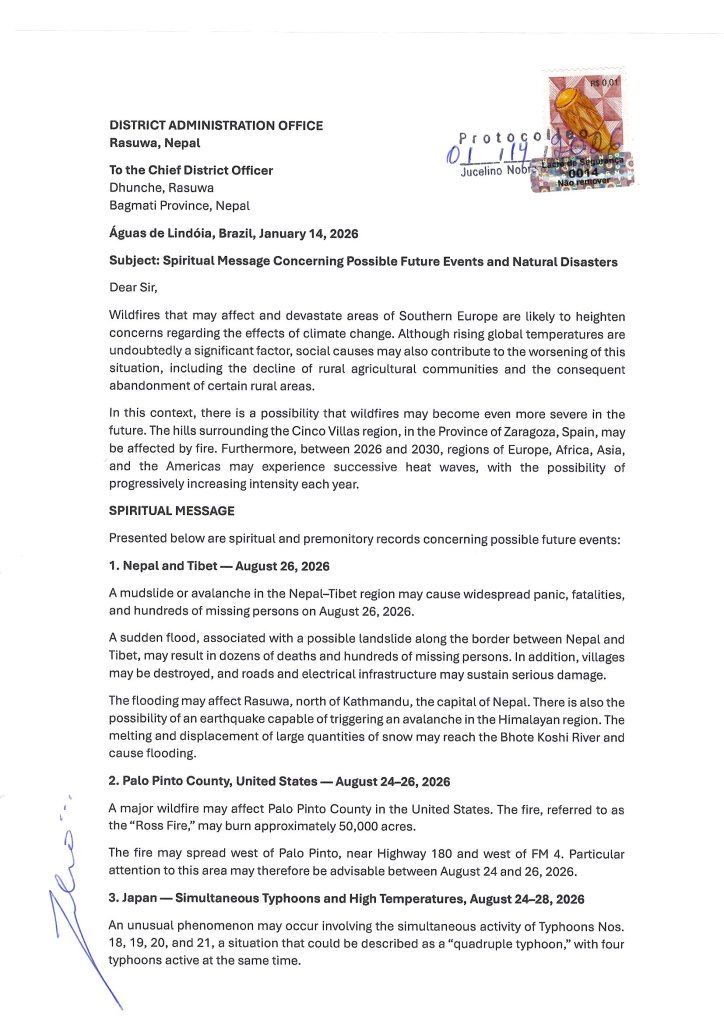
The dates below form part of the predictions and records presented by the author in the original text. They must not be interpreted as technical, scientific, or official confirmation that a particular dam will necessarily fail or collapse on the indicated date.
The document itself clarifies that these dates do not represent predestined outcomes and that events may be subject to changes, occur earlier, or occur later, while preserving the educational, preventive, and emergency-preparedness nature of the message.
Accordingly, the purpose of presenting this information is to encourage inspections, maintenance, monitoring, evacuation planning, community training, and early action by the competent authorities.
1. Mosul Dam — Iraq
Indicated future date: November 15, 2029
Mosul Dam was built on a geological formation containing soluble gypsum, a condition requiring permanent monitoring and maintenance. The original text emphasizes the need for continuous stabilization work and presents the possibility of problems occurring on November 15, 2029.
From a preventive standpoint, potentially affected communities should be familiar in advance with evacuation routes, safe locations, and warning systems.
Foundation maintenance and structural monitoring should receive continuous attention.
2. Oroville Dam — United States
Indicated future date: July 17, 2030
The text recalls the problems that occurred in 2017 involving the main and emergency spillways, a situation that led to the evacuation of approximately 200,000 people. The prediction presented by the author identifies July 17, 2030 as a possible future date of concern.
The 2017 incident demonstrates the importance of periodic inspections, spillway maintenance, emergency testing, and rapid communication with the public.
3. Kariba Dam — Zambia/Zimbabwe
Indicated future date: December 31, 2032
The document draws attention to erosion processes near the base of the dam that could progressively affect its stability. The author presents December 31, 2032 as a possible date associated with a future event.
Preventive efforts should focus on foundation monitoring, erosion control, corrective works, and preparedness of communities located downstream along the Zambezi River.
4. Toddbrook Reservoir, Whaley Bridge — United Kingdom
Indicated future date: August 3, 2034
In 2019, heavy rainfall damaged the auxiliary spillway lining and required a major emergency response. In the document, the author identifies August 3, 2034 as a possible future date of concern.
This case reinforces the need for particular attention to older dams, including rigorous inspection of spillways, drainage systems, and their capacity to respond to extreme rainfall.
5. Dams on the Tigris and Euphrates Rivers — Syria/Turkey
Indicated future date: August 25, 2036
The text highlights dams located in a region affected by conflict, operational difficulties, and periods of insufficient maintenance. It also mentions the Tabqa Dam and identifies August 25, 2036 as a possible future date associated with a collapse.
In politically unstable regions, the protection of facilities, technical maintenance, and continuity of monitoring systems become even more important.
6. Mantaro-Tablachaca Dam — Peru
Indicated future date: May 12, 2036
The text presents concerns associated with erosion and possible structural vulnerability. The prediction associates a potential problem with a combination of climatic changes and a possible magnitude 8.0 earthquake, indicating the date of May 12, 2036.
Preparedness should include seismic monitoring, structural inspections, updated emergency plans, and guidance for communities in the Mantaro Valley.
7. C. J. Strike Dam — United States
Indicated future date: June 14, 2037
Located in Idaho, the dam is presented in the text as a structure requiring attention because of regional seismic activity and the potential for soil liquefaction. The document identifies June 14, 2037 as a possible future date of collapse.
Preventive measures require updated geotechnical studies, seismic monitoring, and a review of evacuation procedures.
8. Dams in the Himalayan Region — India/Nepal
Indicated future date: January 13, 2038
The document draws attention to dams located in a region characterized by high seismic activity and environmental vulnerability. Risks mentioned include earthquakes, glacial lake outburst floods, and landslides. The indicated future date is January 13, 2038.
Preventive measures should integrate engineering, glacier monitoring, meteorological systems, seismic studies, and training for mountain communities.
9. Llyn Brianne Dam — Wales
Indicated future date: September 26, 2029
Although the text itself states that the dam is currently considered safe, it highlights the existence of flood maps for extreme scenarios. The author presents September 26, 2029 as a possible future date of collapse.
Flood maps should be used as planning tools, making it possible to identify evacuation areas and safe routes in advance.
10. Wivenhoe Dam — Australia
Indicated future date: November 30, 2039
During the Queensland floods of 2011, the dam experienced critical storage and discharge conditions. In the document, the author presents November 30, 2039 as a possible future date of collapse.
Safe management depends on reliable weather forecasting, reservoir-level control, proper gate operation, and advance communication with downstream cities.
11. Wolf Creek Dam — United States
Indicated future date: May 23, 2031
The text states that the structure underwent a major rehabilitation program intended to address seepage and internal erosion problems. The prediction presented by the author identifies May 23, 2031 as a possible future date of collapse.
The case demonstrates that, even after major rehabilitation works, monitoring must remain continuous.
12. Dams in North Korea
Indicated future date: October 4, 2031
The document expresses concern regarding dams constructed upstream from densely populated areas near South Korea. The future date indicated by the author is October 4, 2031.
Transboundary issues involving dams require communication, technical cooperation, warning systems, and humanitarian planning.
13. Three Gorges Dam — China
Indicated future date: December 14, 2040
The text highlights the pressure placed on the Three Gorges Dam during periods of major flooding and presents December 14, 2040 as a possible future date associated with problems affecting the structure.
The large concentration of population and economic activity downstream makes permanent monitoring, careful management of water levels, and large-scale emergency plans indispensable.
14. Xiai Reservoir — China
Specific future date: not indicated in the original item
The document states that the reservoir was reportedly built in 2005 and describes episodes involving heavy rainfall, dangerously rising water levels, and the need for substantial reservoir discharges.
The text also describes the consequences of water releases affecting the nearby city of Huangcun.
However, in this specific item, the original text does not provide a future date for a collapse.
For this reason, it is important not to attribute a date that is not expressly recorded in the document.
15. Baipenzhu Reservoir — China
Indicated future date: August 18, 2041
The text describes rising water levels in the Baipenzhu Reservoir associated with heavy rainfall and increasing levels in local rivers. The author identifies August 18, 2041 as a possible future date of collapse.
Preventive measures should include hydrological control, gate maintenance, weather forecasting, warning systems, and evacuation planning for vulnerable areas.
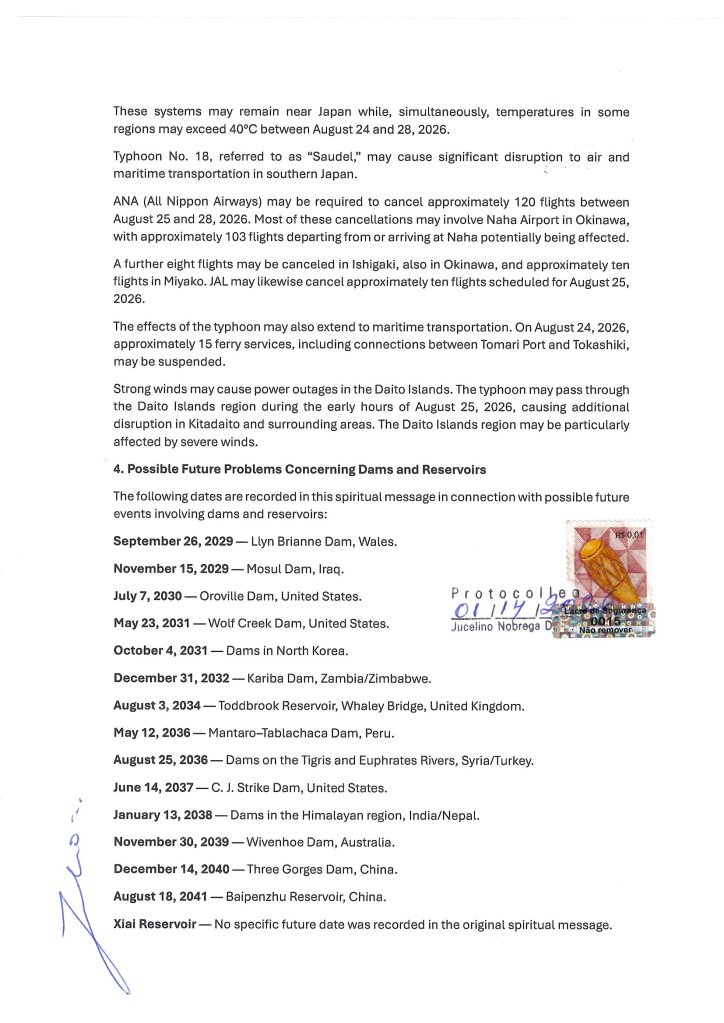
Chronological Table of the Dates Presented
September 26, 2029 — Llyn Brianne Dam, Wales.
November 15, 2029 — Mosul Dam, Iraq.
July 17, 2030 — Oroville Dam, United States.
May 23, 2031 — Wolf Creek Dam, United States.
October 4, 2031 — Dams in North Korea.
December 31, 2032 — Kariba Dam, Zambia/Zimbabwe.
August 3, 2034 — Toddbrook Reservoir, Whaley Bridge, United Kingdom.
May 12, 2036 — Mantaro-Tablachaca Dam, Peru.
August 25, 2036 — Dams on the Tigris and Euphrates Rivers, Syria/Turkey.
June 14, 2037 — C. J. Strike Dam, United States.
January 13, 2038 — Dams in the Himalayan Region, India/Nepal.
November 30, 2039 — Wivenhoe Dam, Australia.
December 14, 2040 — Three Gorges Dam, China.
August 18, 2041 — Baipenzhu Reservoir, China.
Xiai Reservoir — no specific future date recorded in the original item.
Community Preparedness
Regardless of the dates presented, the principal recommendation of this document is that populations living near dams or in potentially flood-prone areas receive appropriate preparation.
The responsible authorities should provide risk maps, evacuation routes, shelter locations, siren systems, emergency notifications, and regular simulation exercises.
8. What Every Community Needs to Know
Every population located in an area potentially affected by a dam should know in advance:
- official evacuation routes;
- assembly points and locations considered safe;
- the meaning of sirens and other emergency warning signals;
- the official communication channels used by the authorities;
- procedures for assisting children, older adults, and people with reduced mobility;
- alternative means of transportation in the event that certain roads are blocked;
- local emergency-service telephone numbers;
- basic first-aid procedures;
- the importance of not returning to an evacuated area without official authorization; and
- the need to maintain a small household emergency kit containing essential documents, water, regularly used medications, and other indispensable items.
Conclusion: Replacing Fear with Preparedness
The central message should be simple:
We do not need to wait for a tragedy before we begin preparing.
Dams will continue to be essential to countless societies. The challenge is to ensure that they are properly inspected, maintained, and modernized while, at the same time, ensuring that potentially exposed populations are informed and prepared.
Governments and operators are responsible for maintenance, regulatory oversight, monitoring, and emergency planning. Local authorities need to ensure effective communication and evacuation systems. Specialists must provide reliable technical information. Communities, in turn, must have access to preventive education.
Predictions should not replace science, engineering, regulatory oversight, or official information. Likewise, uncertainty regarding the future should not be used as a justification for ignoring known risks.
Prevention means identifying warning signs before a problem becomes more serious.
Maintenance means protecting a structure before it deteriorates.
Education means preparing people before an emergency occurs.
The purpose of this message is to contribute to an international culture of prevention, responsibility, and solidarity, encouraging authorities and communities to protect what is of greatest value: human life and the environment.
Jucelino Luz
Journalist, environmentalist, psychoanalyst, influencer, researcher, and spiritual advisor
 JucelinoLuz